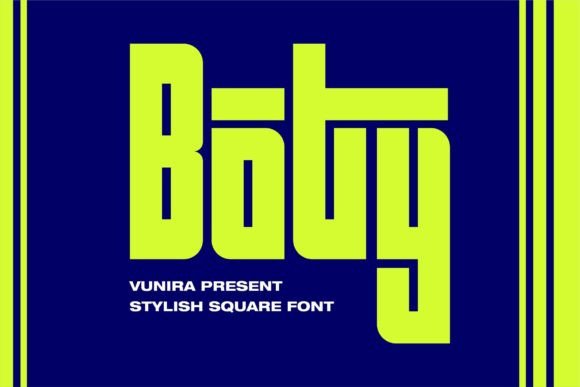
Boty Display Font for Handmade Labels & Printables
As a maker who designs printable wall art, custom candle labels, and wedding welcome signs—every font I choose has to earn its place in my design toolkit. Boty isn’t just another display font. It’s the kind of typeface that makes customers pause mid-scroll, tilt their head, and say, “Where did you get that?” Its clean, futuristic lines and subtle geometric confidence give handmade products an instant lift—without sacrificing warmth or approachability.
Boty shines brightest where impact matters most: short phrases, product names, signage headers, and decorative accents. Think “Small Batch” on a soy wax candle label, “Welcome Home” on a farmhouse-style wooden sign, or “Celebrate” centered boldly on a birthday invitation suite. Its open letterforms and balanced spacing ensure crisp cutting on Cricut and Silhouette machines—even at 0.25 inches tall—and hold up beautifully when printed on kraft tags, glossy stickers, or matte cardstock.
I’ve used Boty across dozens of physical product lines, and what stands out is how it bridges innovation with authenticity. It doesn’t scream “sci-fi”—it whispers “thoughtful design.” That nuance makes it versatile: perfect for a boutique skincare line leaning into clean minimalism, a tech-themed baby shower invitation, or a limited-edition planner collection targeting creative professionals. Because Boty reads as fresh—not flashy—it supports your brand voice instead of overriding it.
For printable creators, Boty works especially well in layered digital downloads. Try pairing it with a soft handwritten font for “Hand-poured • Small Batch • Made in Portland” labels—or set it against a muted serif for elegant wedding stationery where “Mr. & Mrs.” appears in Boty and the rest of the text flows in something timeless like Playfair Display. When designing SVG files for crafters, I always test Boty at 3–5 sizes: it stays legible down to 14pt for small gift tags, and scales impressively up to 120pt for large-format wall art or chalkboard-style shop signage.
Readability in production is non-negotiable—and Boty delivers. Its uppercase-heavy character set (with strong, unambiguous letterforms like R, G, and Q) eliminates confusion during vinyl cutting or laser engraving. No overlapping strokes, no fragile serifs, no ambiguous terminals. On matte-finish sticker sheets, Boty’s contrast holds up without ink bleed; on ceramic mugs or tote bags, its geometry translates cleanly through sublimation and screen printing. I’ve even used it successfully on seasonal packaging—think Boty spelling “Cozy Season” on holiday tea box wraps or “Sunshine & Saltwater” on summer soap labels.
Pairing Boty thoughtfully expands its usefulness. For contrast-rich layouts, I often combine it with a relaxed script (like “Lavanderia” or “Maiden Orange”) for names or quotes, then anchor the layout with a neutral sans serif (e.g., Montserrat or Inter) for body text, ingredients, or care instructions. In wedding suites, I’ll use Boty for headings and a classic serif (such as Crimson Text or Lora) for ceremony details—creating hierarchy without visual noise. The key is letting Boty lead the eye, then supporting it with fonts that recede gracefully.
Boty comes as a single-weight display font—no bold or italic variants—but that’s part of its strength. Its clean structure means it doesn’t need stylistic flourishes to stand out. It includes standard OpenType features like discretionary ligatures and alternate characters, which add subtle polish to invitations or digital templates without requiring manual tweaking. File formats are practical: OTF and TTF, ready for Canva, Affinity Designer, Adobe Illustrator, and Cricut Design Space. While it’s optimized for English-language projects, its Latin character set covers accented letters common in Spanish, French, and German—handy for bilingual boutique tags or international Etsy listings.
Licensing is where many makers trip up—so let me be clear: Boty is a commercial font, meaning you’re fully covered to use it in physical products you sell (candle labels, greeting cards, iron-on transfers), digital downloads (printable planners, SVG bundles, Canva templates), and client work (logo concepts, social media graphics, packaging mockups). Just avoid embedding it directly into editable web fonts or reselling the font file itself—that’s standard practice across reputable font vendors. Keep your license active, and you’re golden for Etsy shops, Shopify stores, and local craft fairs alike.
In practice, Boty saves time *and* elevates perception. A customer seeing Boty on your product tag doesn’t just register the words—they register intention. They sense care in the typography, consistency in your visual language, and attention to detail that extends beyond the product itself. That’s why I reach for Boty when launching new collections: it quietly signals quality before a single word is read.
Whether you're hand-lettering a welcome board for a pop-up shop, designing printable graduation announcements, or building a cohesive label system for a line of artisanal hot sauces—Boty gives your work distinction without distraction. It’s not trying to be everything. It’s doing one thing exceptionally well: making your handmade message look unmistakably yours.